Cost Assessment
Planning to hold a presentation on solar hat applications in your country? Thinking about posting news articles to your website? Use the solar heat cost charts available for download here and reference @Solar Payback/IRENA 2022.
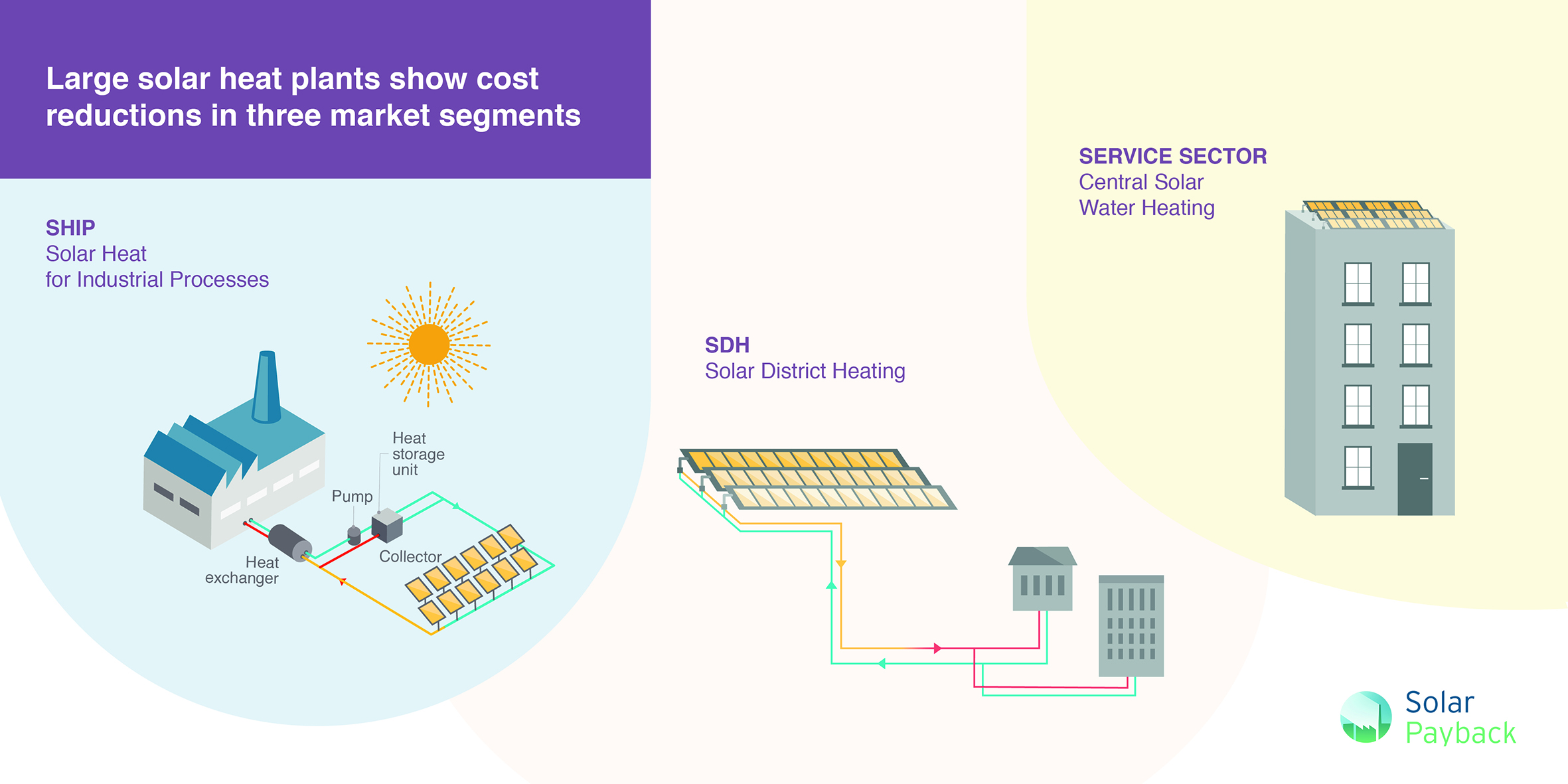
Large solar heat plants show cost reductions in three market segments
In the category of large solar heat plants, there are three main types of clients: industries with a high energy demand for heat (SHIP), utilities running district heating networks (SDH) and buildings from the service sector (hospitals, hotels, sport centres, multi-family houses etc.).
 Download the chart
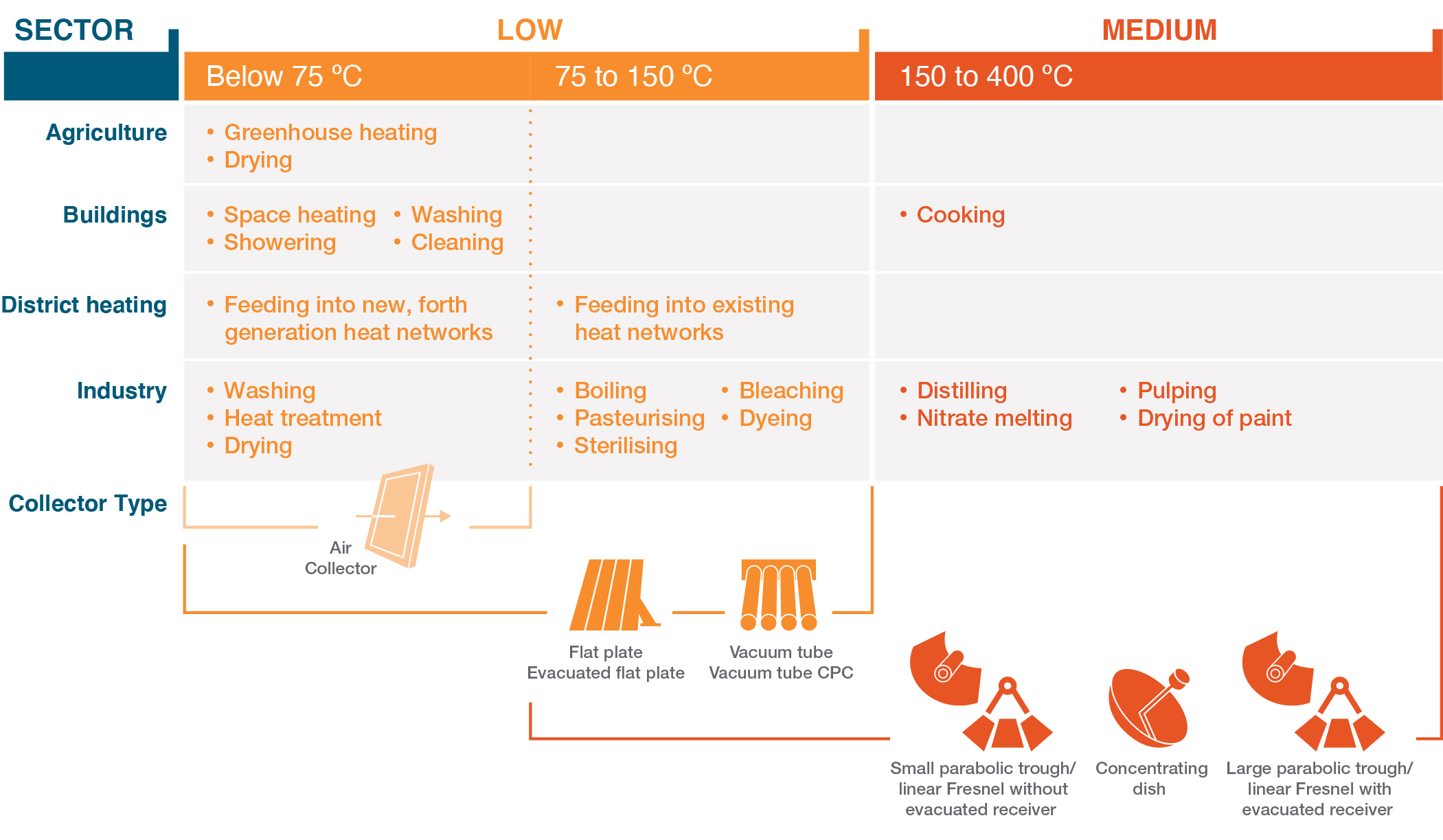
Collector types supply different temperature levels
For solar thermal systems, the collector type depends on the type of client with its required temperature. The necessary solar thermal equipment for various temperature levels have a significant impact on the costs.
Trends of solar heat costs of major markets
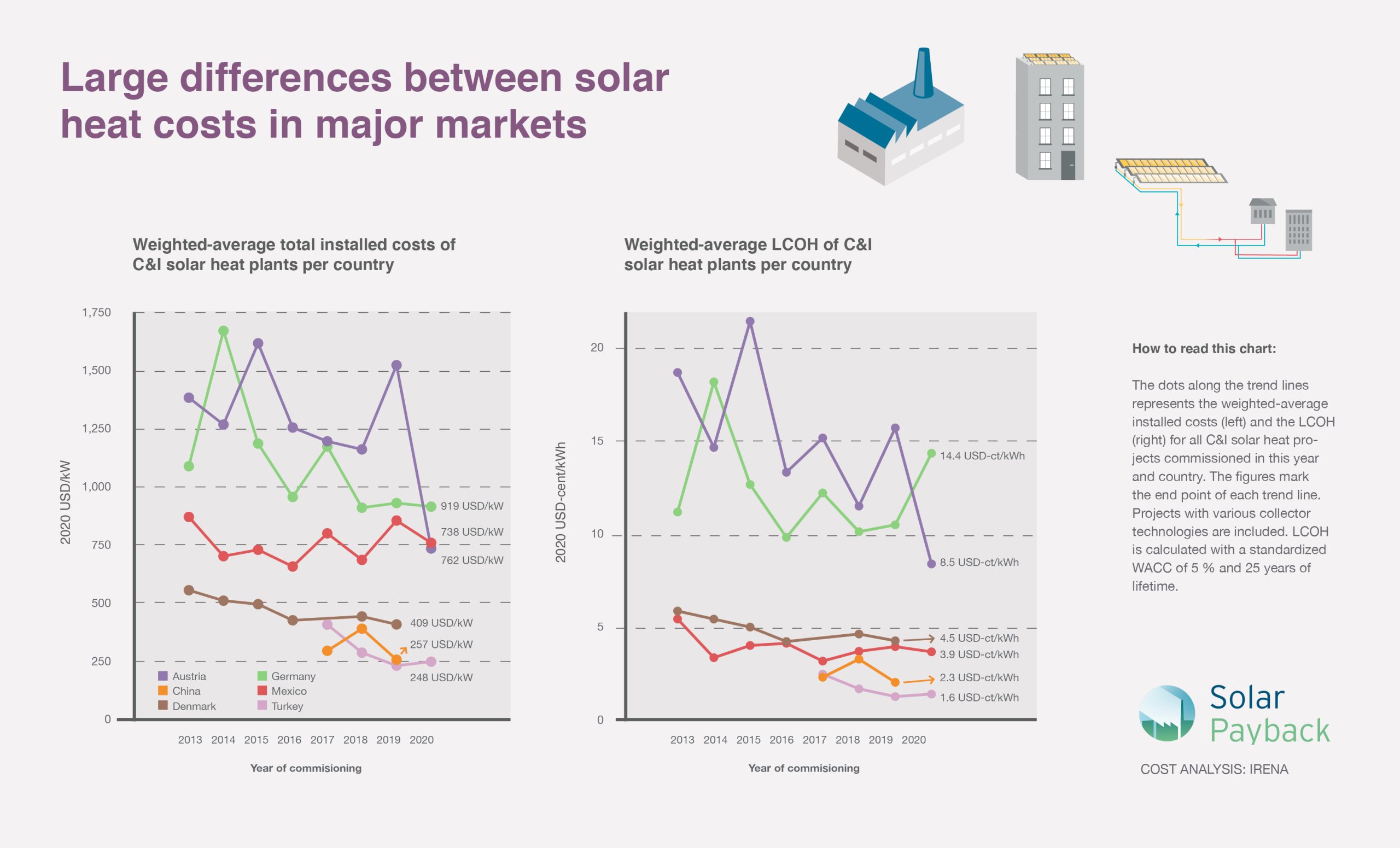
Weighted-average total installed costs and levelised cost of heat are shown for all commercial & industrial solar heat plants in major markets. The figures mark the end point of each trend line. Projects with various collector technologies are included.
Solar heat costs for different applications in out outside Europe
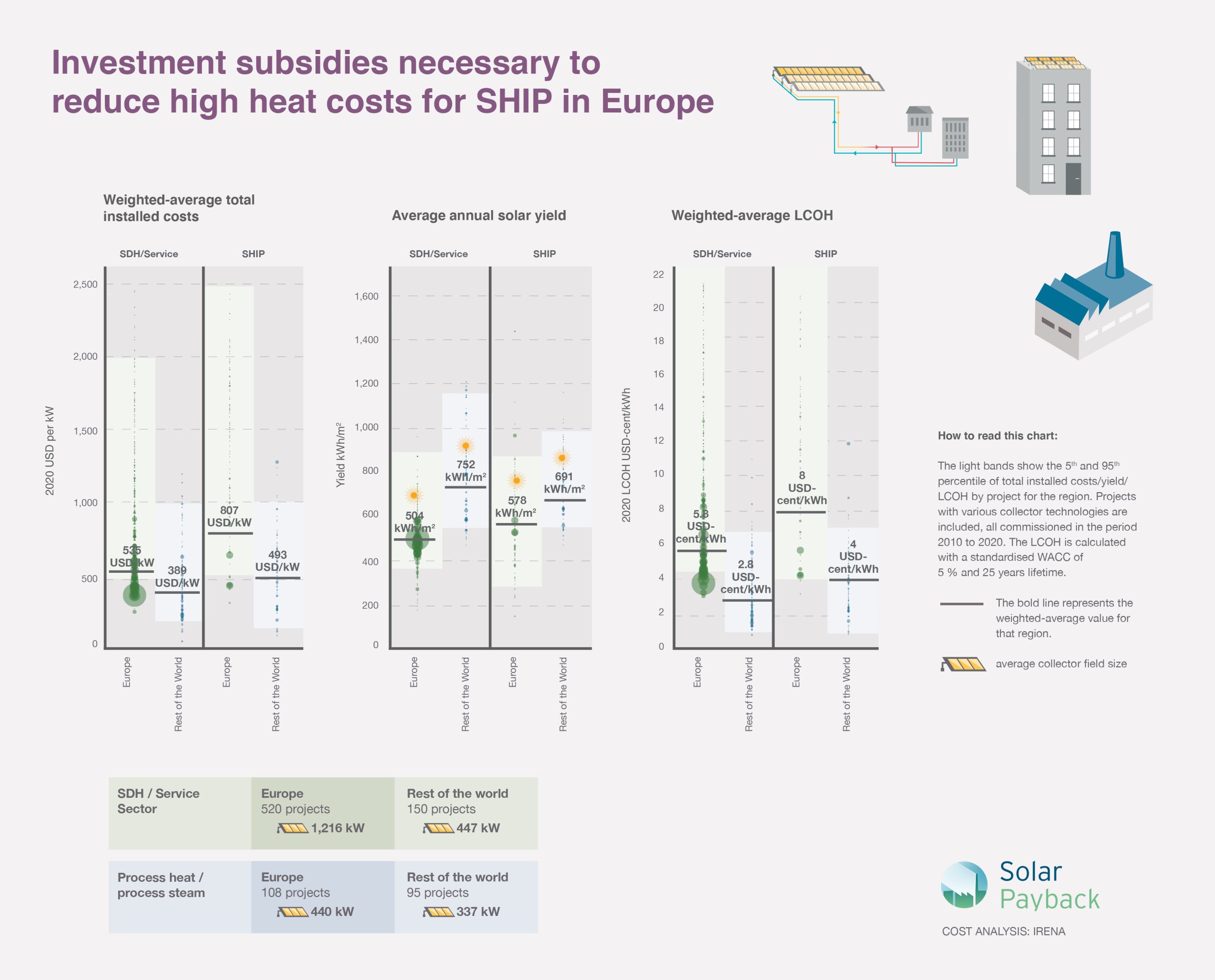
Total installed costs of solar thermal systems in industry are in average higher than of those systems in the building or energy sector. Solar industrial heat plants, therefore, merits financial support particiulary in Europe, while fossil fuels don’t pay for their negative externalities.
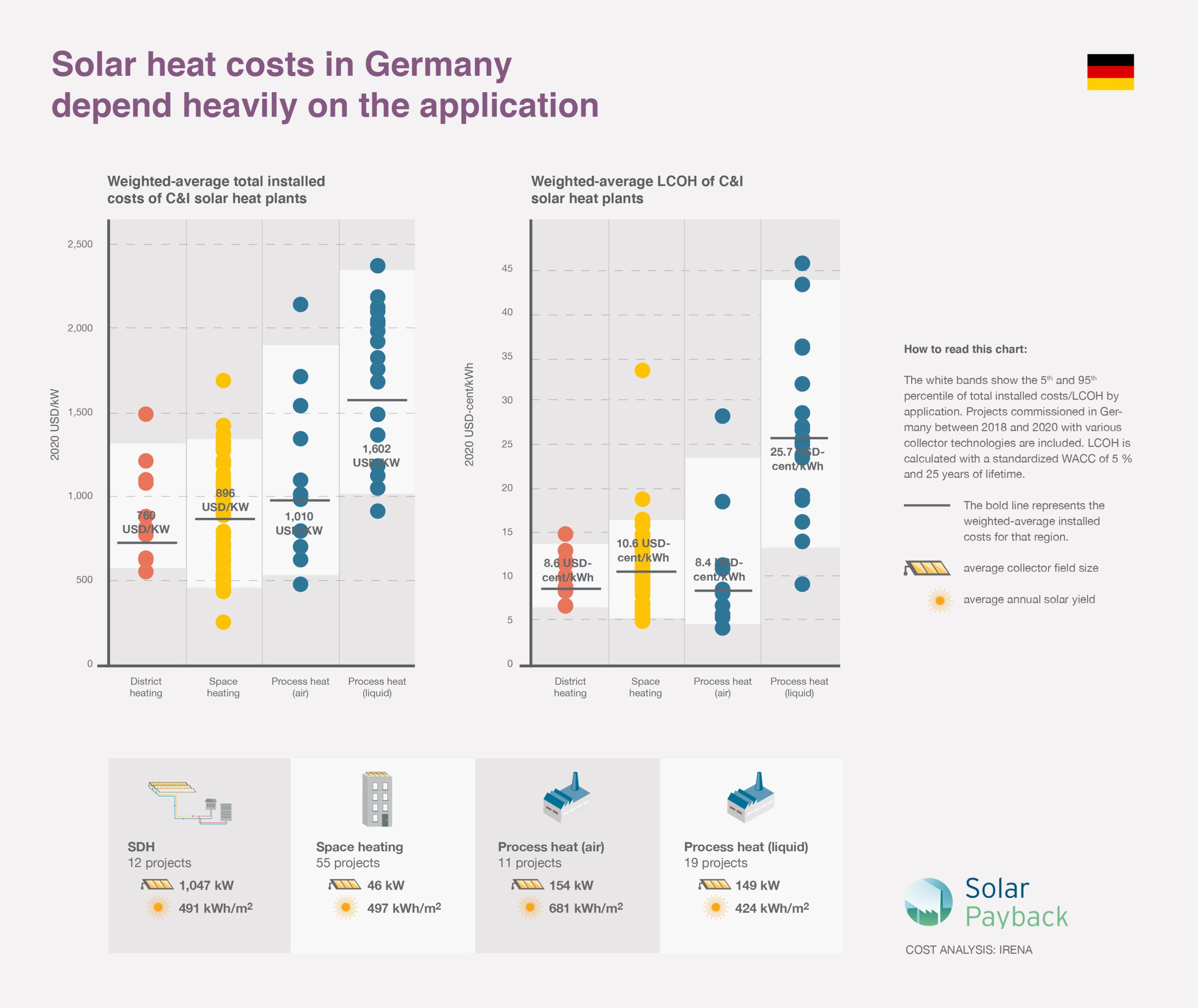
Solar heat costs in Germany depending on application
Costs for 97 solar thermal systems commissioned in Germany between 2018 and 2020 are marked with dots on this chart. The four applications show a different cost structure. The data was provided by the administrator of the national subsidy scheme.
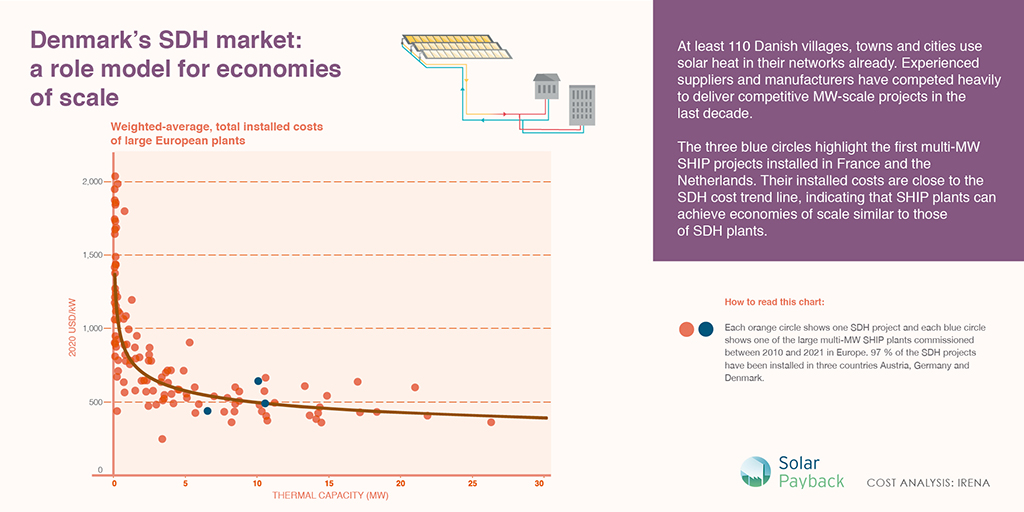
Denmark's SDH market: a role model for economies of scale
The European SDH market has achieved great economies of scale due to Denmark’s leading role. Each orange circle shows one SDH project and each blue circle shows one of the large multi-MW SHIP plants commissioned between 2010 and 2021 in Europe. The trend curve suggests that for every doubling of the size of the plant, total installed costs will decline by 14 %.
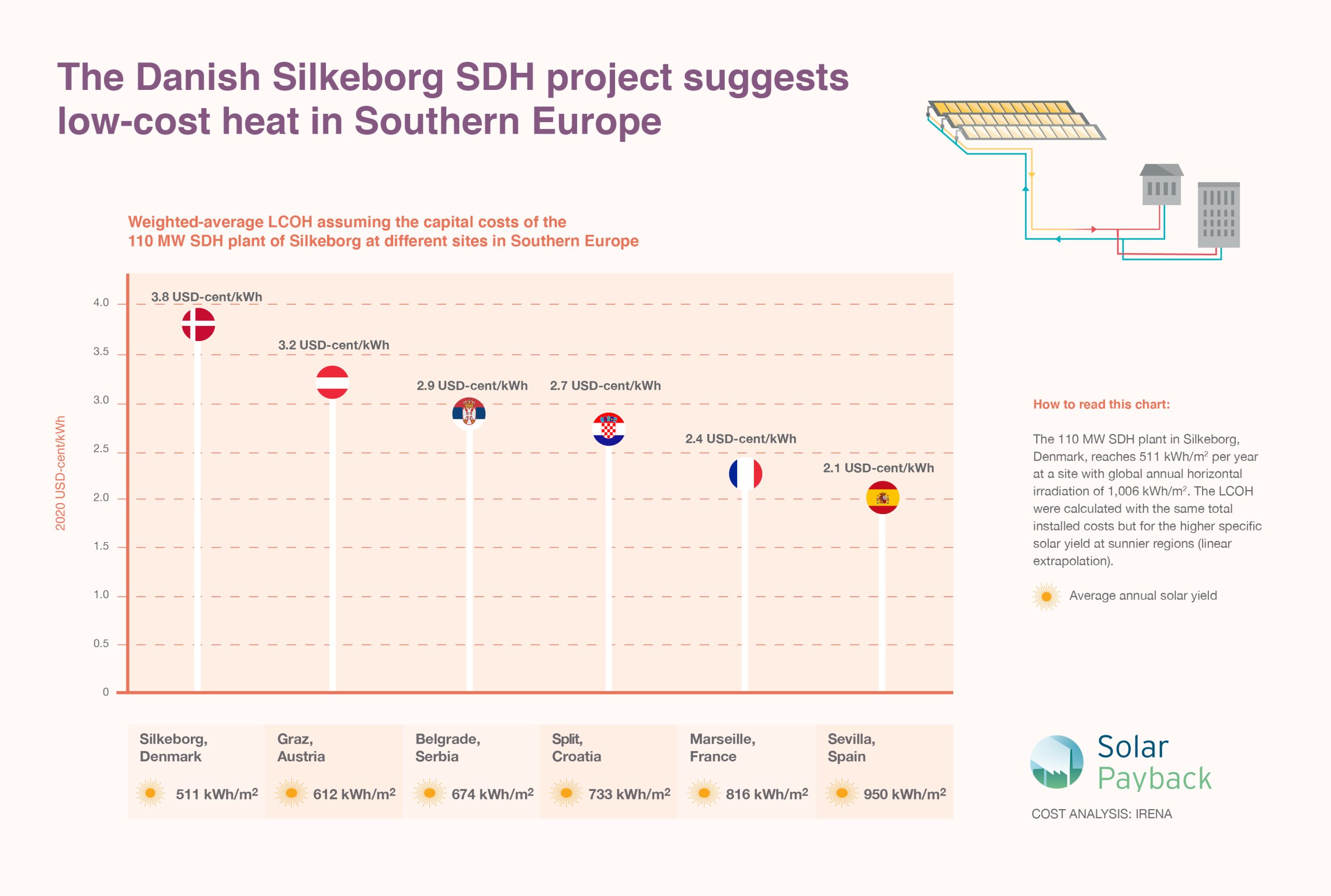
Solar district heating costs as various European sites
The 110 MW SDH plant in Silkeborg, Denmark, reaches 511 kWh/m2 per year
at a site with global annual horizontal irradiation of 1,006 kWh/m2. The levelised cost of heat were calculated with the same total installed costs but for the higher specific solar yield at sunnier regions (linear extrapolation).
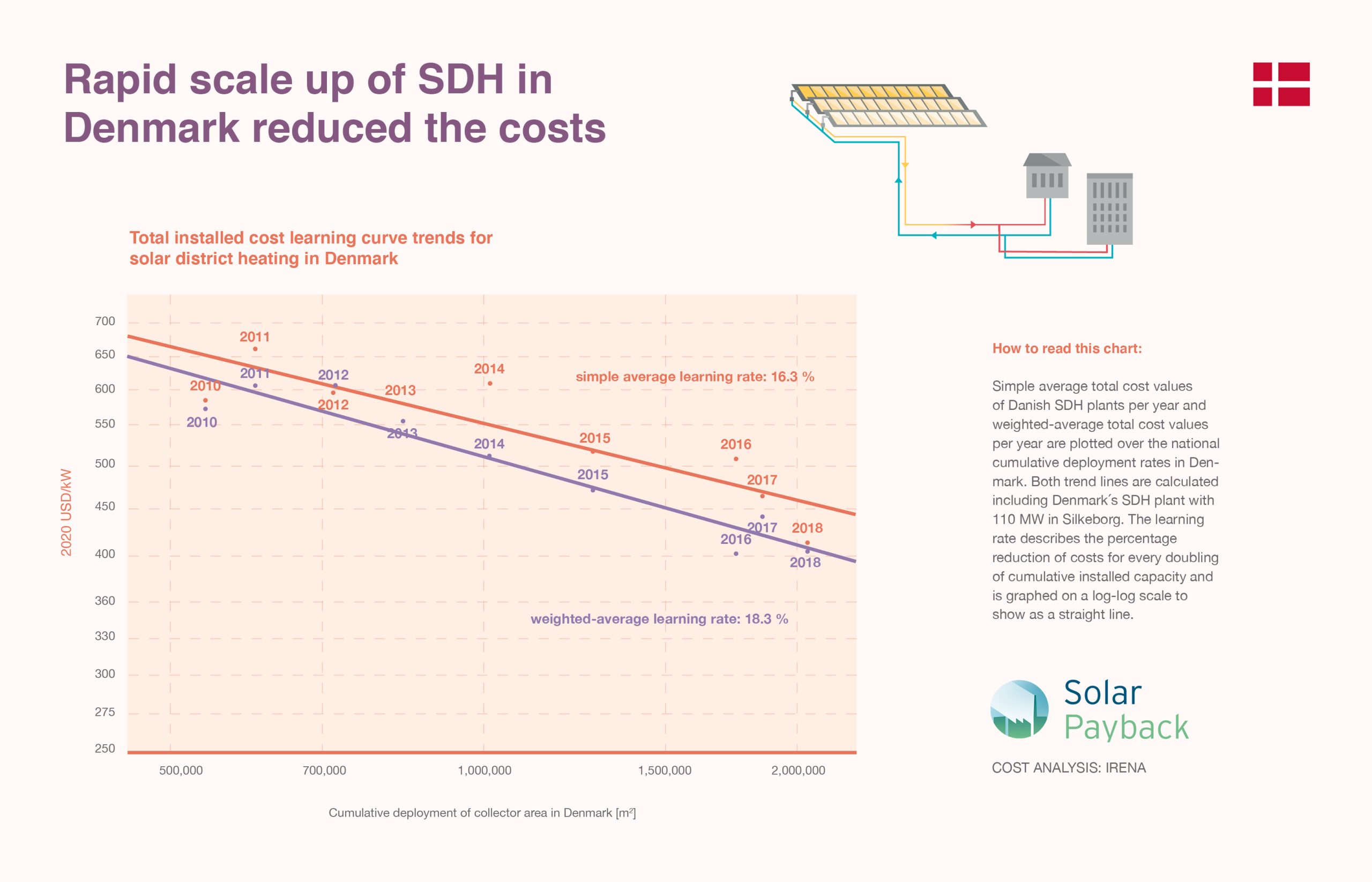
Learning rate for solar district heating in Denmark
In this chart simple average total cost values of Danish solar district heating plants per year and weighted-average total cost values per year are plotted over the national cumulative deployment rates in Denmark. Both trend lines are calculated including the Danish plant with 110 MW in Silkeborg. The learning rate describes the percentage reduction of costs for every doubling of cumulative installed capacity and is graphed on a log-log scale to show as a straight line.